


Affiliate marketing is one of the few online business models where you don’t need to build a product, manage inventory, or handle customer support — and yet it can still generate real, recurring income.
You’ve probably clicked an affiliate link today without even noticing: a “buy on Amazon” button under a blog post, a discount code shared by a YouTuber, or a Pinterest pin linking straight to a product page.
This guide covers everything a beginner needs: what is an affiliate marketing?, how to start affiliate marketing from scratch, how to evaluate affiliate marketing programs, which platforms works best (including Pinterest affiliate marketing, which is often overlooked), and how to identify the best affiliate programs for your niche.
Table of Contents
What Is Affiliate Marketing?
Affiliate marketing is a performance-based partnership. A business agrees to pay a commission to an individual or company (the affiliate) for driving sales, leads, or traffic through a unique tracking link. No sale, no commission — that’s what makes it “performance-based,” and it’s also why it’s so appealing to brands: they only pay for measurable results.
For the affiliate, it’s an opportunity to monetize an audience — a blog, a Pinterest account, a YouTube channel, an email list — without ever creating or owning the product being sold. You recommend something you believe adds value, someone clicks your link and buys, and you earn a commission out of it.
Global affiliate marketing spend is estimated in the tens of billions of dollars annually, and it keeps growing as brands shift budget toward channels that only pay for measurable outcomes.
How Affiliate Marketing Works?
Every affiliate transaction typically involves four parties:
- The merchant (or advertiser) — the business that owns the product or service.
- The affiliate (or publisher) — the person or company promoting the merchant’s product to their audience.
- The affiliate network (optional but common) — a middleman platform that connects merchants with affiliates, handles tracking, and processes payments.
- The customer — the person who clicks the affiliate link and completes the desired action.
Here’s the typical flow:
- An affiliate joins an affiliate marketing program (directly or through a network) and receives a unique tracking link.
- The affiliate places that link in content — a blog post, a Pinterest pin, a video description or in any social media post.
- A visitor clicks the link. A tracking cookie is dropped in their browser, recording the affiliate’s ID and a timestamp.
- If the visitor completes a qualifying action within the “cookie window” (commonly 24 hours to 90 days, depending on the program), the sale is attributed to the affiliate.
- The affiliate earns a commission, usually paid out monthly once a minimum payout threshold is reached.
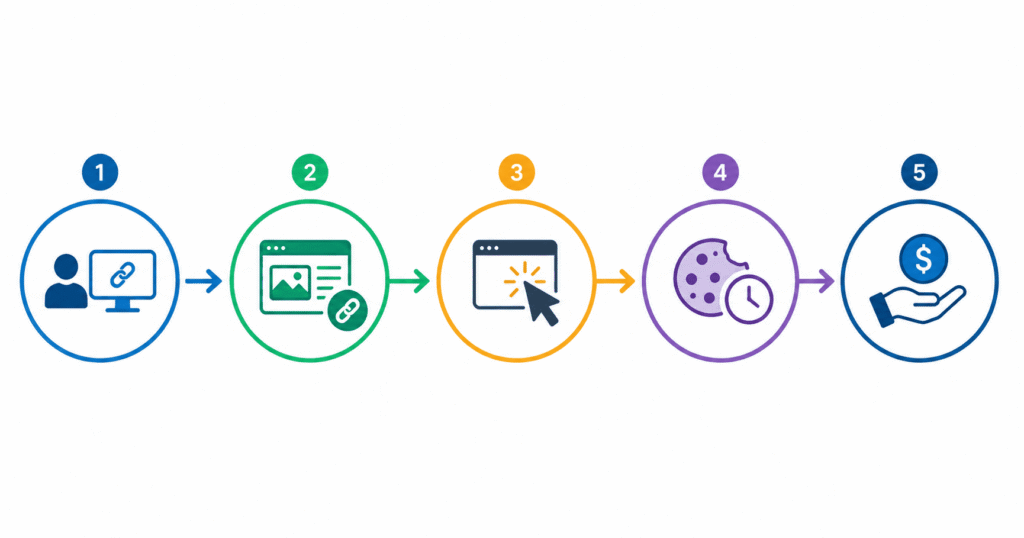
The cookie window matters more than most beginners realize. A 24-hour cookie only credits you if someone buys within a day of clicking. A 30- or 90-day cookie gives you a much longer runway to earn credit for that same sale.
Affiliate Marketing for Beginners: How Payouts Work?
Not all affiliate marketing programs pay the same way. Understanding the different commission structures helps you evaluate which ones are actually worth your time.
Pay-per-sale (PPS) is the most common model. You earn a percentage of the sale price (typically 5–10% for physical products, and 20–50% for digital products and software) or a flat fee per transaction.
Pay-per-lead (PPL) pays you when someone takes a specific action — signing up for a free trial, requesting a quote, filling out a form — no purchase required. Common in finance, insurance, and B2B software.
Pay-per-click (PPC) pays a small amount for every click your link generates, regardless of what happens afterward. Less common today due to fraud risk.
Pay-per-install (PPI) is typically used for apps and software, paying a commission each time someone installs a program through your link.
Recurring commissions are worth calling out separately — many software and subscription affiliate marketing programs pay a percentage every month for as long as the customer stays subscribed, not just on the initial sale. These compound as your audience grows, which is why many experienced affiliates consider them the best affiliate programs to prioritize.
How to Start Affiliate Marketing: A Step-by-Step Process
1. Choose a Niche You are Interested
If you have urge to pick the niche that looks most profitable on paper and get more revenue. Resist that. Affiliates who last are the ones who can keep producing content long after the initial motivation fades — genuine interest matters as much as market size.
Look for a niche where:
- There’s an audience actively searching for information or recommendations.
- Relevant affiliate marketing programs exist with reasonable commission rates.
- You can bring a distinct angle that generic content doesn’t already cover.
A niche like “Best equipment for home workouts” will almost always outperform a broad niche like “fitness,” because it speaks directly to a specific reader’s problem.
2. Pick the Right Platform for Your Audience
Your platform should match both your niche and your natural strengths. This is one of the most important early decisions, since the best affiliate marketing platforms for one creator won’t necessarily be the best for another.
- A blog or website — ideal for in-depth reviews, comparisons, and how-to content that ranks in search engines and keeps generating traffic long after publication.
- Pinterest — often underrated for affiliate marketing. Pinterest affiliate marketing works well because pins function like visual search results with long shelf lives, sending steady traffic to product pages, blog reviews, or roundup posts for months or even years after a single pin goes up. It’s especially effective in niches like home decor, fashion, recipes, DIY, and personal finance, where visual browsing drives purchase intent.
- YouTube — well suited to product demonstrations, unboxings, and comparison reviews.
- Instagram and TikTok — effective for visual, fast-consumption content and building a following that trusts your taste.
- Email newsletters — arguably the most valuable long-term asset, since you own the list rather than renting attention from an algorithm. But you need to be careful while sending newsletters, because if your emails are landing to junk/spam folders then your success rate will be less.
Many successful affiliates combine two or three of these — for example, a blog that funnels traffic into an email list, reinforced by a Pinterest strategy that continuously drives new visitors to older content.
3. Join the Best Affiliate Programs and Networks
You have three main ways to find affiliate marketing programs worth joining:
- Affiliate networks like Awin, CJ Affiliate, Impact, ShareASale, and ClickBank, Warrior Plus aggregate thousands of merchants in a single dashboard, simplifying tracking and payments.
- Direct/in-house programs — search “[brand name] + affiliate program.” Many companies run their own programs outside of networks, sometimes with better commission rates since there’s no network fee taken off the top.
- Marketplace programs like Amazon Associates — useful for broad product categories, though commission rates tend to be lower than niche-specific programs.
When comparing programs to find the best affiliate programs for your niche, look past the commission rates like
- Cookie duration (longer is generally better)
- Payment threshold and payout reliability
- Product return rates (high returns quietly eat into commissions)
- Whether commissions are recurring or one-time
4. Create Content That Actually Helps People
The affiliates who succeed long-term produce content that would be genuinely useful even without an affiliate link attached. Strong formats include:
- In-depth product reviews that cover real strengths and weaknesses.
- Comparison posts (“Product A vs. Product B”) that help an undecided buyer choose.
- Buying guides aimed at a specific use case or budget.
- Pinnable roundup graphics — for Pinterest affiliate marketing specifically, vertical images with clear text overlays (“10 Best X for Y”) tend to perform best, since they’re built to be saved and re-shared.
5. Drive Traffic Consistently
Content without traffic doesn’t earn commissions. Depending on your platform, this might mean:
- Optimizing content for search engines around specific, buyer-intent keywords.
- Publishing consistently on Pinterest with keyword-rich pin titles and descriptions, since Pinterest functions more like a visual search engine than a typical social feed.
- Building an email list from the very beginning, even before you have significant traffic.
- Testing small paid advertising budgets once you understand which content converts.
6. Track Performance and Refine Your Approach
Once commissions start coming in, track click-through rates, conversion rates by traffic source, and which content generates the most revenue. This tells you where to double down — guessing is far less efficient than measuring.
Best Affiliate Marketing Platforms to Consider
As per the market below are the best affiliate marketing platforms to start with:
- Amazon Associates — broad product catalog, useful for beginners despite lower commission rates.
- Awin — large international network with a wide range of merchants across industries.
- CJ Affiliate — long-established network with big-name brands.
- ShareASale — popular with smaller and mid-sized merchants, easy for beginners to get approved.
- Impact — used by many software and subscription brands, strong for recurring-commission programs.
- ClickBank — focused heavily on digital products and info products, with high commission percentages.
Pairing one or two of these networks with a strong content platform (a blog or Pinterest, for example) is a common, low-risk way to start.
Disclosure: A Non-Negotiable Part of Affiliate Marketing
Affiliate marketing is legal and widely practiced, but transparency isn’t optional. Regulators such as the FTC in the United States require affiliates to clearly disclose when a link is an affiliate link. A simple, visible statement — “This post contains affiliate links, and I may earn a commission if you make a purchase” — placed near the top of content or near the link itself is typically sufficient. This applies to Pinterest pins and social captions too, not just blog posts.
Common Mistakes to Avoid
- Promoting too many products at once, which dilutes credibility.
- Choosing a niche purely for profitability without genuine interest, making it hard to sustain output through slow early months.
- Ignoring email list building, leaving you dependent on platforms you don’t control.
- Skipping disclosure, which risks both legal trouble and lost trust.
- Treating Pinterest as an afterthought — many beginners overlook it entirely, missing one of the more beginner-friendly platforms for driving consistent, long-lasting traffic.
How Much Can You Realistically Earn?
Affiliate income varies enormously and rarely arrives quickly. Most beginners earn very little in their first several months while building an audience and refining their content. As traffic and trust grow, income tends to scale — results depend heavily on niche, audience size, content quality, and consistency over time. There’s no shortcut that replaces sustained effort.
FAQs: Affiliate Marketing for Beginners
Is affiliate marketing still worth starting in 2026?
Yes. Demand for performance-based marketing keeps growing, and new platforms like Pinterest and TikTok have opened up traffic sources that didn’t exist a decade ago. It’s more competitive than it used to be, but there’s still room for focused, niche-specific content.
What’s the fastest way to start affiliate marketing with no experience?
Pick one platform (a blog or Pinterest are both beginner-friendly), join one or two reputable affiliate marketing programs in a niche you understand, and publish a small number of genuinely helpful pieces of content before worrying about scale. Trying to run five platforms and ten programs at once is the most common early mistake.
Do I need a website for Pinterest affiliate marketing?
Not always — some affiliate marketing programs allow direct linking from a pin to the product page. However, routing pins through your own blog post or landing page tends to convert better and gives you more control if a program changes its linking rules.
How do I know if an affiliate program is one of the best affiliate programs for my niche?
Compare commission rate, cookie duration, payment reliability, and whether the product itself has strong reviews. A high commission on a low-quality product will hurt your credibility more than it helps your income.
Final Thoughts
Affiliate marketing rewards patience and authenticity over short cuts. The path that works looks like this: pick a niche you can stick with, choose a platform (or combination, including Pinterest) that fits your strengths, join reputable affiliate marketing programs, create genuinely useful content, disclose your relationships honestly, and keep refining based on real data. It’s not passive income in the way it’s sometimes marketed — the early effort is significant — but for beginners willing to put in consistent work, it remains one of the more accessible ways to build an online income stream without ever creating a product of your own.